
Be sure to grab your FREE download below, “Conquering Sleep Regressions”.
Your baby was sleeping beautifully, and then one week everything fell apart. Naps are short or gone, bedtime takes an hour, and you're up at 2 AM wondering what you did wrong. You didn't do anything wrong. I work with families through this every week, and nearly every child hits at least one of these rough patches between birth and age four.
Here's when they tend to show up, what nap refusal is, and what I'd do about it.
What is a sleep regression?
A sleep regression is a stretch of a few weeks when a child who was sleeping well suddenly doesn't. Naps get shorter, bedtime turns into a battle, or night wakings return. Almost always, there's a developmental reason behind it: a new skill, a growth spurt, a change in how their sleep cycles work, or a nap that's due to change.
Sleep regression ages: the common windows
Every child runs on their own timeline, so treat these as rough windows and not exact dates.
Birth to 3 months. There's no true regression yet. Newborn sleep is all over the place, and the rough nights usually come from growth spurts and your baby sorting out day from night.
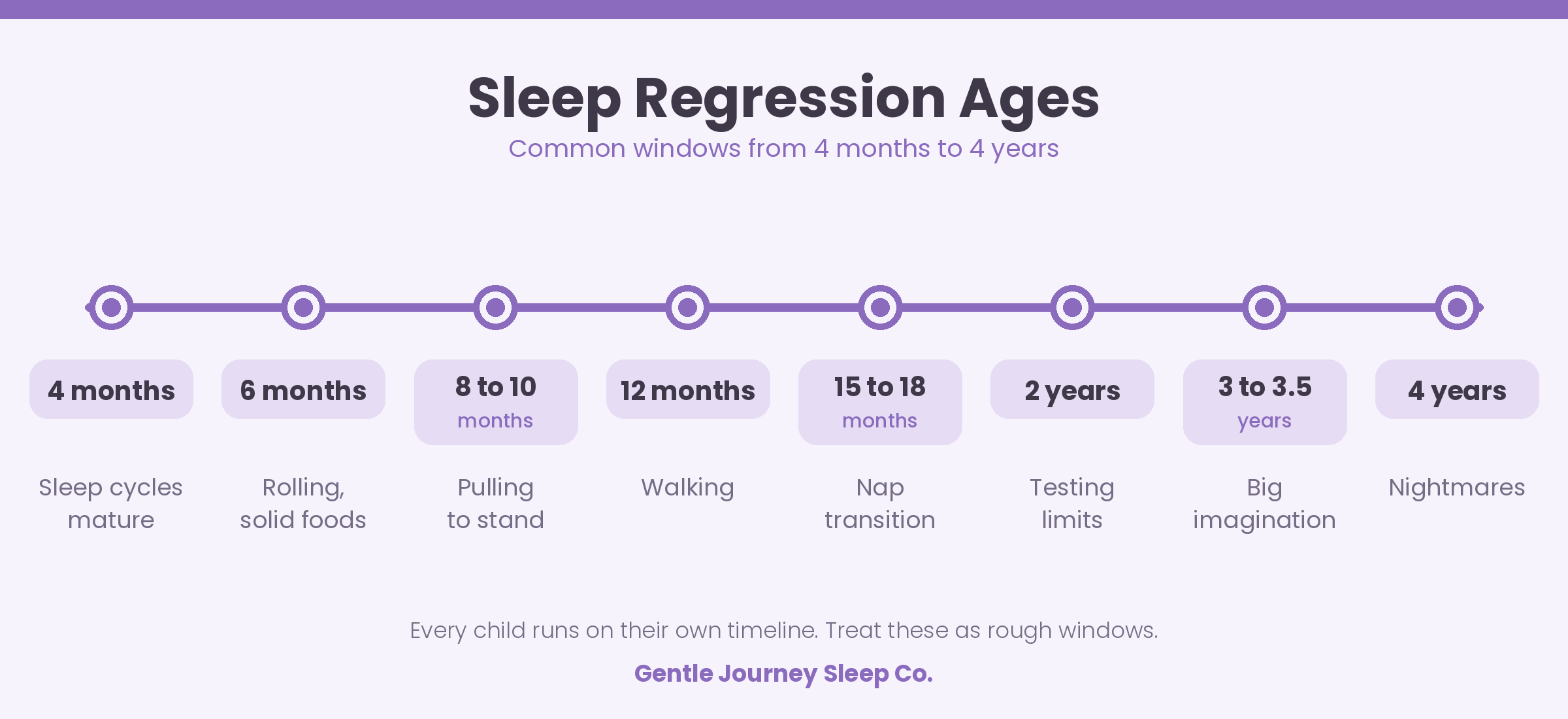
4 months. This is the big one. Your baby's sleep cycles mature and start to look more like ours, which means more waking between cycles. Unlike the others on this list, this change sticks around. What shifts is how your baby gets back to sleep.
6 months. Some babies sail through, and some don't. If yours struggles, it often lines up with rolling, starting solids, or a nap change.
8 to 10 months. Crawling, pulling up, and a clingy streak all arrive together. This is when I see the jack-in-the-box phase, with babies standing in the crib and not sure how to get back down.
12 months. Walking, a pile of new skills, and often a nap that needs adjusting.
15 to 18 months. The shift from two naps to one tends to land here, along with a big surge of independence.
2 years. Bedtime stalling, testing limits, new words, and new fears.
3 to 3.5 years. A big imagination moves in, and so do fears at night. The nap often starts to come apart around now too.
4 years. Nightmares are common, and most kids are finished with naps.
What is nap refusal?
Nap refusal is when a child who still needs a nap fights it. They might protest, chat or play in the crib, take forever to settle, or sleep for twenty minutes when they used to sleep for ninety. It often happens during a regression or a big developmental leap, but a schedule that's a little off can cause it too.
What to do if your child still needs a nap

Hold off on dropping it. Refusing a nap doesn't mean your child is done with naps, and I see families give up too early all the time. Here's what I'd try first.
Look at the wake window. If it's too short, they aren't tired enough yet. If it's too long, they're overtired and wound up. A small adjustment in either direction can change everything. Keep offering the nap at the same time and in the same place, with a short routine beforehand. Predictability matters more than whether the nap actually happens that day. When they protest, give them a little room before you step in, and keep your response calm and brief. If the nap doesn't happen, what I'd do depends on your child's age. For children under 2, we use the crib hour. Give your child about 60 minutes in the crib to attempt to sleep.
Kids this age still need naps, so keep offering the chance, even on days it doesn't go well. For children 2 and older, switch to rest time.
That means about an hour in their room, playing quietly with calm toys (nothing bright or loud), looking at books, or lying down. They don't have to sleep, but they do have to stay in their room. Most kids between 2 and 4 will go back to napping on their own, and until they do, they're still getting the downtime they need to recharge. If a nap gets missed or turns out very short, move bedtime earlier to make up for the lost daytime sleep, so the tiredness doesn't stack up from one day to the next.
How to tell if your child is ready to drop the nap
A child who's ready is usually in a good mood all day, has no meltdowns in the late afternoon, and sleeps well at night even without the nap. A child who still needs it tends to be cranky in the evening, wake early in the morning, or need a bedtime that keeps creeping earlier.
How long do sleep regressions last?
Most regressions and nap refusals run about two to six weeks. The 4-month change is the exception, since it's permanent. If nap refusal lasts more than two or three weeks with no sign of easing, I start thinking it's a schedule mismatch or a nap transition, not a regression.
When to get help with your child's sleep
If you've been through a few weeks of rough sleep and nothing is improving, or you're not sure which of these you're dealing with, you don't have to white-knuckle it alone. Every child is different, so I look at your child's schedule, feedings, development, and temperament and build a plan that fits your family. Book a free call HERE, and we'll figure out your next step together.
FREE DOWNLOAD: “Conquering Sleep Regressions”