
If your baby will only go down while nursing, or your toddler needs you flat on your back next to their crib every single night, you've probably already heard the term "sleep association" thrown around. Maybe you've also heard "sleep crutch," which sounds a little harsher but means basically the same thing.
Here's what I want you to know before we get into any of it: this isn't a parenting failure. Every person who has ever slept, at any age, falls asleep attached to something. You probably have your own version — a certain pillow, a fan running, your phone face-down on the nightstand just so. The difference with babies is that their version usually involves a person. And that person is you.
That's really the whole issue in a nutshell. It's not that your child has a habit. It's that the habit requires you to physically show up, every time they stir, for the rest of the night.
So what exactly counts as a sleep crutch?
Basically, anything your child leans on to get from awake to asleep, and anything they go looking for the moment they surface out of a light sleep cycle in the middle of the night. In our coaching work, the ones we see over and over are:
Nursing or a bottle right up until eyes close. Being rocked, bounced, or held. A car ride or a lap around the block in the stroller. A pacifier that has to get popped back in every hour. A parent lying down in the room, or in the crib, until they're fully out. Being patted or shushed continuously, the entire way down.
None of these are wrong or bad or spoiling anyone. They're just... learned. Your child's brain has filed away "this is how sleep happens," and every time you repeat it, that filing gets a little more permanent.
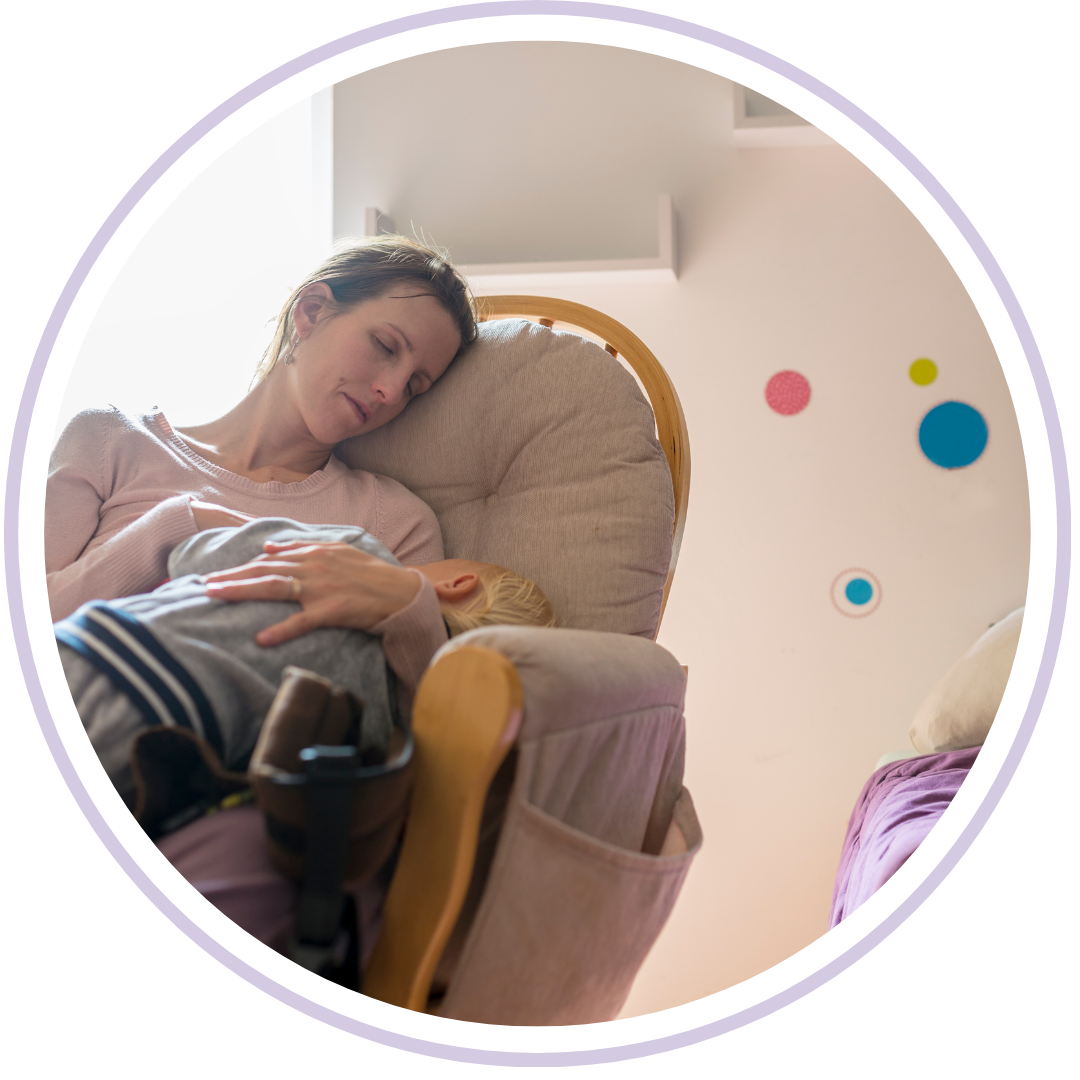
Why does this feel like such a fight?
Because it kind of is one — and not because your child is being difficult. Change is genuinely hard for little kids, in the same way it's hard for grown adults, except toddlers don't have the vocabulary to say "I'm uncomfortable with this new thing," so it comes out as crying, clinginess, or refusal instead.
A few things going on underneath that:
If rocking or nursing is the only route to sleep your child has ever known, you're not asking them to tweak a habit. You're asking them to learn something completely new, usually at 7pm when nobody involved has much patience left in the tank.
Kids also find enormous comfort in things staying the same. Predictability is safety, at that age. So even a gentle, gradual shift in the bedtime routine can register as "wait, something is different," before it ever gets the chance to register as "oh, this is fine now."
And the protest itself — the whining, the reaching for you, the fighting sleep altogether — isn't defiance. It's just what change looks like on a kid who's never had to do this differently before. If your plan is met with pushback, that doesn't mean the plan is wrong. It usually just means it's new.
None of this is helped by the fact that the old pattern has probably been rehearsed hundreds of times by now. A habit that's been practiced every night for months doesn't unwind in one night, no matter how good the plan is.

Okay, so how do you actually remove it?
There's no single script that works for every kid, and honestly, I'd be a little wary of anyone who tells you there is. What tends to work is picking an approach that fits your specific child and your own comfort level, then sticking with it long enough to actually see if it's working. Broadly, families end up somewhere on this spectrum:
Some fade the crutch out slowly — a little less rocking each night, or staying in the room but not touching, before eventually stepping fully back. Others tackle one piece at a time, separating the feed from the falling-asleep part first, and dealing with presence later. Some parents want to stay close by the whole time, checking in frequently while their child practices the new skill, rather than leaving them to work it out solo. And some kids, depending on age and temperament, do better with a quicker, more direct shift once they're developmentally ready for it.
What matters more than which one you pick is that it actually fits your kid — a plan copied off a forum for someone else's baby is not the same as one built around yours. That's usually the piece a sleep consultant is actually helping with: not a magic method, but the right method for the child in front of us.

What replaces the crutch
This is the part that catches parents off guard. Once you take away the rocking, or the nursing, or your physical presence in the room, your child still has to get themselves to sleep somehow. They don't just skip that step. They build a new one.
And it usually looks a little odd at first. You might see your kid rubbing their head back and forth against the mattress. Or fussing softly for a few minutes — not full crying, just a kind of processing-out-loud — before settling. Flopping from side to side, repositioning half a dozen times before they land somewhere comfortable. Rubbing a hand or a foot along the sheet. Rocking their own body a little. Reaching for a lovey and working it into position themselves.
The first time you catch your child doing one of these, it can look strange, maybe even a little concerning. It's not. It's actually the goal. They're figuring out their own way in, instead of waiting for you to do it for them.
Why 4 to 6 months specifically
This age window keeps coming up in sleep coaching for a reason, and it's not arbitrary. Somewhere in this stretch, babies' sleep cycles start maturing into something closer to an adult pattern — more distinct stretches of light and deep sleep, rather than the shorter, less organized cycles of the newborn stage. At the same time, they're picking up the physical skills that make self-soothing possible in the first place: bringing hands to their face, rolling, reaching for something nearby.
Put those two things together, and you get a baby who is, for maybe the first time, actually capable of settling themselves for short stretches without help. That's why this window shows up in so many sleep plans. It's not that 8 weeks is "too soon" to try, it's that the tools a baby needs for this simply aren't online yet at that point. By 4 to 6 months, for most babies, they are.
If you're stuck on this right now
If your kid has a sleep crutch you're ready to let go of, the hard part you're feeling isn't a sign you're doing this wrong. It's just what change feels like, for both of you. That's true whether you're weaning off nursing at 2am, moving out of a shared bed, or trying to get out of the room at bedtime without a meltdown.
I built Gentle Journey Sleep around the idea that sleep is something you build with your kid, not something you enforce on them. No cry-it-out required, no ignoring your gut. If you want a plan that actually fits your family instead of a method you found online, let's talk.